
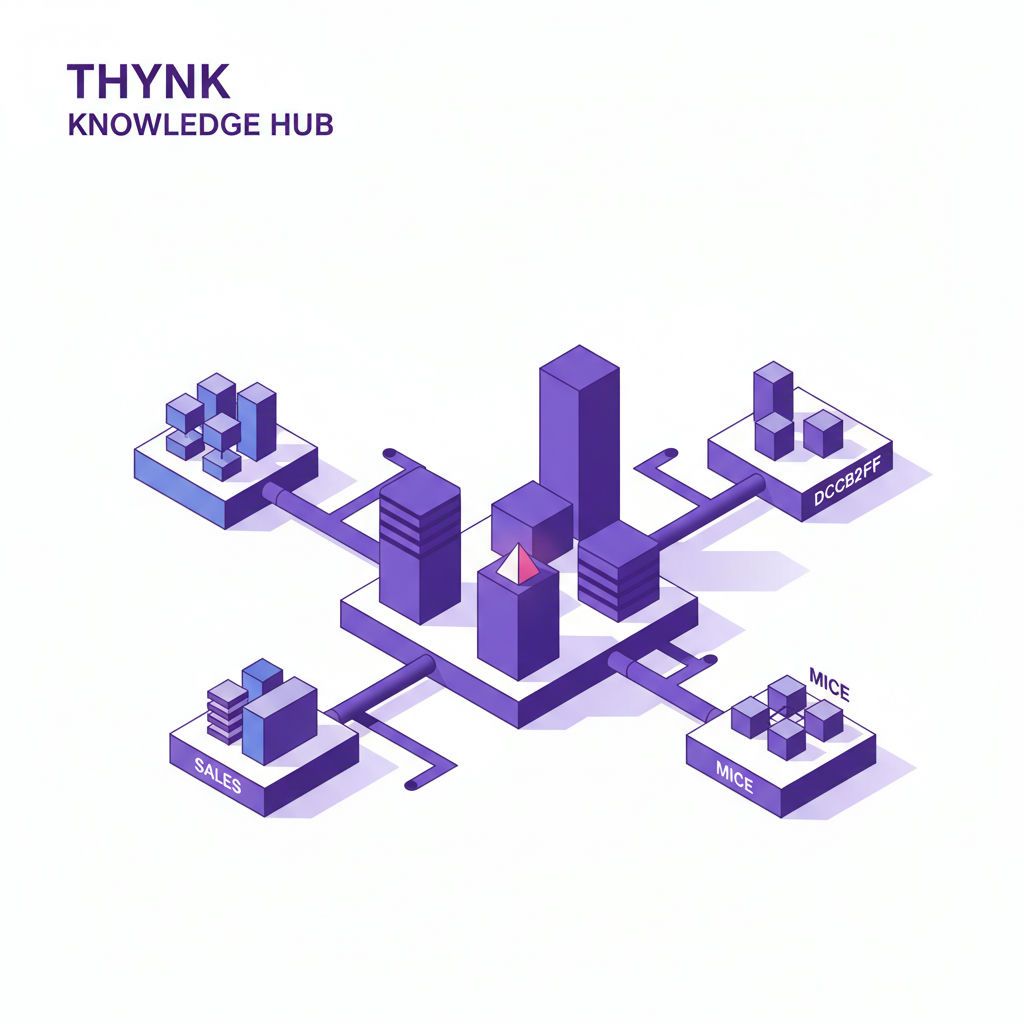
Hospitality CRM: Salesforce-Native Platform for Hotel Group Sales & Revenue
Thynk runs natively on Salesforce, unifying group, MICE, and corporate business into a governed system of record with Agentforce agents, Einstein Trust Layer oversight, and direct PMS integration. This eliminates duplicate data entry, manual RFP parsing, and finance reconciliation—delivering clean data, sales automation, and real-time revenue visibility for hotels, venues, and convention centers at enterprise scale.
Why Legacy Hotel CRM Bleeds Revenue
Traditional hotel CRM treats group sales as an afterthought: bolted onto property-management systems or siloed in event tools that lack account hierarchy, AI parsing, or cross-property visibility. Sales teams juggle spreadsheets for multi-site proposals, re-key RFP details from email into disconnected screens, and discover finance discrepancies between CRM and PMS only at month-end close.
The cost: 41 percent of sales capacity lost to administrative overhead. Delayed responses to high-value group inquiries. Missed cross-sell when a corporate account books leisure, meetings, and extended-stay across the same portfolio.
Legacy platforms also lack semantic data models. An RFP arrives; a sales manager manually creates an opportunity, types arrival dates into free-text fields, attaches the original PDF. When the client books, reservation details live in the PMS while the CRM holds a stale snapshot—forcing finance to reconcile folio line items against outdated pipeline. This delays revenue recognition, obscures true pickup against group allocations, and prevents proactive yield decisions.
Salesforce-Native Architecture for Hospitality
Thynk inherits Salesforce's enterprise data model, security architecture, and AI infrastructure without custom integration debt. Every group inquiry, proposal, booking, and revenue event exists as a governed Salesforce record—queryable by Agentforce, visible in unified dashboards, auditable under Einstein Trust Layer policies.
Single Source of Truth Across Group Business
Thynk's B2B CRM unifies corporate accounts, travel agencies, tour operators, and group planners into a single account hierarchy with roll-up reporting. A national corporate client with negotiated rates, preferred properties, and multi-year volume commitments appears as one entity. Property-level Opportunities retain local detail for e-proposals, room blocks, and banquet-event-order workflows.
Sales managers view consolidated pipeline, won business, and revenue contribution across all touchpoints—no duplicate records, ghost accounts, or manual merges from legacy acquisitions. Account hierarchy surfaces cross-sell: when the same corporate client inquires about a meeting at Property A and an incentive trip at Property B, both sales teams see the full relationship and coordinate pricing.
AI Email Parsing and Autonomous RFP Routing
Agentforce agents parse inbound group RFP emails—extracting arrival date, departure date, room-night requirements, meeting-space needs, budget parameters—and create structured Opportunities without manual data entry. AI triage scores each lead by conversion probability (historical win patterns, segment profitability, booking-window fit), routes qualified RFPs to the property or GSO team best positioned to close, and drafts initial responses using rate logic and availability from connected PMS systems.
This automation cuts RFP response time from hours to minutes, ensures no inquiry vanishes into inbox clutter, and frees sales teams for high-touch negotiation, site visits, and account relationship management. Agentforce learns which clients book consistently, which segments convert at higher margins, which inquiry patterns signal low-intent tire-kickers—refining lead-scoring models without manual rule updates.
Group CRS and Multi-Property Proposals
Thynk's Group CRS lets global sales organization teams search real-time inventory across properties, build multi-property proposals in a single workflow, and present unified pricing for clients booking room blocks at multiple locations. E-proposal generation pulls live availability from Opera, Mews, Stayntouch, or Protel PMS platforms, applies negotiated corporate rates, and produces client-ready PDFs with terms, floor plans, and package details.
Room-block management tracks definite bookings, tentative holds, and pickup against contracted allocations—surfacing attrition risk before it impacts revenue. Property revenue managers see group commitment alongside transient forecast, enabling holistic yield decisions: if a high-value group shows weak pickup, the revenue manager releases inventory to transient channels before the commitment window closes.
Multi-property coordination streamlines global account management. When a pharmaceutical company books a training series across six properties in three countries, the GSO team builds a single master proposal, allocates room-night commitments by location, and tracks deposit milestones in one consolidated view—not six separate contracts from disconnected property systems.
PMS Integration and Finance Parity
Thynk integrates directly with Opera, Mews, Stayntouch, and Protel PMS platforms, synchronizing reservation data, folio line items, and posted charges bidirectionally. This parity means group revenue, deposit schedules, and cancellation penalties in Thynk match PMS finance down to the line-item level—eliminating reconciliation cycles and enabling real-time PACE reporting that finance teams trust.
When a group books 200 room nights with a $50,000 F&B minimum, the PMS sees the same reservation structure, rate code, and revenue allocation as the CRM. If the client reduces the block or cancels a function, the update flows instantly to both systems—keeping pipeline forecasts, definite-group reports, and general-ledger feeds in sync.
This bidirectional flow prevents the common hotel scenario where sales celebrates a "won" opportunity while finance discovers weeks later that the booking was never confirmed in the PMS. Finance parity also unlocks accurate group-revenue forecasting: deposit milestones, attrition clauses, and payment schedules sync with the PMS, so finance teams model cash flow against definite bookings—not stale pipeline estimates—and revenue managers compare current-year group pace to prior-year performance at the same point in the booking cycle.
MICE and Event Workflows in One Platform
MICE business—meetings, incentives, conferences, exhibitions—demands function-space scheduling, banquet-event-order workflows, and product-package management alongside traditional room-block sales. Thynk combines all three in a unified interface: sales managers convert an Opportunity into a definite booking, operations teams generate BEOs for catering and AV setup, finance tracks deposit milestones and final billing in the same record.
Space and meeting-room management prevents double-booking, visualizes setup-and-teardown timelines, and integrates with floor-plan tools for client approval. Product and package management lets properties bundle room nights, F&B minimums, and AV credits into repeatable offers—accelerating quote turnaround and standardizing pricing across portfolio brands.
For example, a global hotel group creates a "Corporate Offsite" package: two nights' accommodation, full-day meeting space, breakfast and lunch F&B, and standard AV. Sales managers apply the package to new Opportunities with a single click, adjust room-night allocations or meeting dates as needed, and generate client proposals that reflect consistent pricing and terms—whether the inquiry arrives in New York, London, or Singapore.
Lead Scoring, Intelligent Routing, and Distribution
Thynk's lead-scoring engine evaluates inbound RFPs by historical conversion rate, segment profitability, booking-window fit, and account-tier priority. Scored leads route automatically to the property or GSO team best positioned to win—based on availability, segment expertise, and workload balance.
Lead distribution rules ensure high-value corporate accounts always reach senior sales managers with relationship context, while transient group inquiries flow to property coordinators who specialize in one-off bookings. This intelligent routing reduces response latency, maximizes win rate for strategic segments, and prevents high-intent RFPs from sitting unassigned in a shared inbox.
For portfolio operators, automated routing balances workload across sales teams. If a property's GSO is at capacity, overflow inquiries route to regional specialists or sister properties with availability—ensuring every qualified lead receives a timely response without manual triage by a sales director.
Revenue Analytics by Source, Account, and Segment
Thynk's revenue analytics surface ROI by lead source—Cvent RFP integration, direct booking engine, GroupSync marketplace, agency referral—account tier, and customer segment. Sales leaders identify which channels deliver the highest-margin group business, which corporate accounts warrant dedicated account-manager investment, and which segments show the strongest pickup against forecast.
PACE and GRC (group revenue contribution) reporting compare current-year group bookings to prior-year performance at the same point in the booking cycle, enabling proactive sales interventions when pace lags. If corporate-segment bookings trail last year by 15 percent but association bookings exceed forecast, the sales team reallocates prospecting effort and adjusts channel-marketing spend before the gap widens.
Source-attribution analytics also inform channel-partner negotiations. If Cvent RFP delivers 30 percent of inbound group volume but only 12 percent of won revenue, the hotel may renegotiate commission structures or shift investment toward direct channels with higher conversion rates.
Channel Hub and Multi-Channel Connectivity
Thynk's channel hub consolidates group inquiries from Cvent RFP, Cvent Supplier Network, GroupSync, direct website forms, and email into a single lead-management queue. Each channel retains its native workflow—Cvent RFPs auto-populate Opportunities with structured data, email inquiries pass through AI parsing—but all routes converge in Thynk for unified response and tracking.
MCP (Model Context Protocol) connectivity allows Agentforce agents to query external systems, retrieve live PMS availability, and draft contextual responses without manual lookup—reducing the time from inquiry receipt to client-facing proposal. An agent receives a Cvent RFP for a 150-room block in March; the Agentforce agent queries the PMS for availability, checks historical corporate-rate agreements, drafts a proposal with floor plans and terms, and routes the opportunity to the appropriate sales manager—all before a human reviews the lead.
This multi-channel orchestration eliminates the common hotel problem where RFPs from different sources create duplicate Opportunities, ghost accounts, and conflicting proposals. Thynk deduplicates by client domain, inquiry fingerprint, and account hierarchy, ensuring one corporate client with multiple inquiries across channels appears as a single account with linked Opportunities.
Key Outcomes for Hotel Group Sales and Revenue
Salesforce-native architecture inherits Einstein Trust Layer, Agentforce agents, and AppExchange connectivity without custom integration debt, enabling governed AI and enterprise-grade security.
Unified B2B CRM with account hierarchy consolidates corporate, agency, tour-operator, and group accounts into a single source of truth with roll-up reporting and cross-sell visibility.
AI email parsing and RFP automation convert unstructured inquiries into scored, routed Opportunities—cutting response time from hours to minutes and eliminating manual data entry.
Group CRS and multi-property proposals enable GSO teams to search real-time inventory, build unified proposals, and manage room blocks across portfolio brands in one workflow.
PMS finance parity synchronizes reservation data and folio line items with Opera, Mews, Stayntouch, and Protel, eliminating reconciliation cycles and enabling accurate PACE reporting against definite bookings.
MICE workflows combine space scheduling, e-BEO management, and product-package configuration in the same platform as group sales—streamlining handoff from sales to operations and finance.
Revenue analytics and source attribution surface performance by lead source, account tier, and segment, guiding sales-investment decisions, channel-partner negotiations, and prospecting allocation.
Thynk is the AI-first commercial platform for hospitality—built on Salesforce to deliver clean data, sales automation, and governed AI at enterprise scale. To explore how Thynk compares to legacy meeting and event platforms, visit Thynk Alternatives. For definitions of group-sales terminology and hospitality concepts referenced in this article, see the Thynk Glossary. To learn how Agentforce agents automate RFP workflows and lead routing, read How Agentforce Agents Transform Hotel Sales.