What US Hotels Can Learn from Europe's Meetings & Events Revenue Strategies
European hotels are outpacing the US in M&E revenue by treating properties as ecosystems, automating group bookings, and using data to drive cross-team collaboration.
Question answered in this article:
What US Hotels Can Learn from Europe's Meetings & Events Revenue Strategies
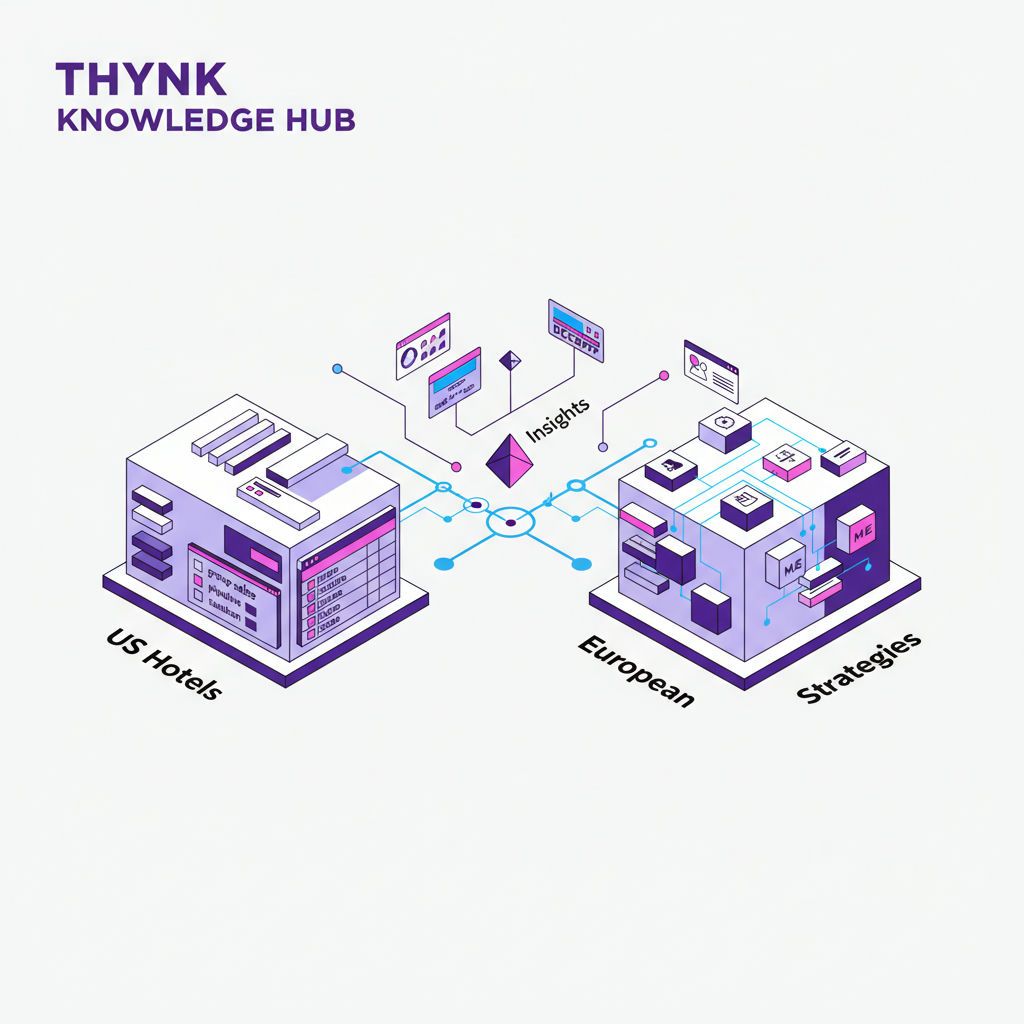
What US Hotels Can Learn from Europe's Meetings & Events Revenue Strategies
European hotels reached $114.40 billion in revenue by end of 2024, surpassing the US market's $110.60 billion — proof that holistic M&E revenue management drives measurable results. The difference comes down to treating every space as a revenue center, automating group bookings through Salesforce-native platforms, and using clean data to align sales and operations. US properties can close the gap by adopting Europe's three strategic pillars: space optimization, automated group sales, and data-driven decision-making.
Why Europe Leads in Meetings & Events Revenue
European hoteliers see properties as living ecosystems where meeting rooms, F&B, AV equipment, and event spaces each contribute to total revenue. This mindset unlocks streams US hotels often leave on the table — premium add-ons, experience-led packages, and proactive upselling — all powered by Meetings & Events software that unifies sales, operations, and finance in Salesforce.
The shift from room-rate optimization to holistic revenue management requires platforms that manage room blocks, function spaces, and ancillary services in one system. Spreadsheets and siloed tools can't capture the full revenue potential of modern group bookings. Salesforce-native architecture ensures every inquiry, proposal, and confirmed event flows through a single source of truth.
Europe's lead isn't cultural — it's operational. Properties there adopted AI-first platforms and unified commercial systems three to four years ahead of US counterparts. The result: faster response times, higher conversion rates, and revenue per square meter that outpaces traditional approaches.
Make Every Space Work for You
European properties maximize revenue per square meter by treating meeting spaces, F&B outlets, and event areas as integrated profit centers. This requires Meetings & Events software that eliminates handoffs between sales and operations, ensuring every booking captures its full revenue potential from first inquiry to post-event reconciliation.
Offer All-Inclusive Packages
Bundle meeting spaces with F&B, AV equipment, and team-building activities to simplify client decision-making and showcase full value. Comprehensive packages differentiate your property in competitive group RFP responses, especially when paired with instant pricing and availability.
Salesforce-native platforms like Thynk Group CRS automate multi-property proposals and product management, enabling sales teams to generate e-proposals with bundled offerings in minutes. This capability sits within Thynk's Sales & CRM stack, which includes lead-to-account matching, Opportunity workflows, and Agentforce-powered RFP triage. Properties that respond to RFPs with structured packages in under 24 hours win more business — and modern platforms make that turnaround the new standard.
Package management isn't static. Version offerings per property, brand, or market segment, then surface the right bundle in proposals with one click. This reduces proposal time from hours to minutes while ensuring consistency across sales reps and properties.
Empower Upselling at Every Stage
Train sales teams to highlight premium add-ons: upgraded catering, VIP accommodations for event attendees, or breakout-zone setups. With AI email parsing and lead scoring, Thynk automatically surfaces upsell opportunities in Salesforce Opportunities — no manual combing through RFPs required.
This aligns with the AI & Agents layer of Thynk's capability stack, where Agentforce handles routine qualification while human teams focus on relationship-building and strategic account expansion. When a client books a 100-person meeting, AI flags opportunities for executive suites, team dinners, or late-checkout packages — all in the same Opportunity record where sales manages the core booking.
Upselling works when it's timely and contextual. Real-time room-block pickup and BEO management give operations visibility into attendee counts, enabling proactive F&B adjustments and AV upgrades that turn potential friction into revenue growth.
Sell Experiences, Not Just Spaces
Shift from renting rooms to crafting tailored event experiences. A client booking a meeting room should feel they're investing in an elevated event, not just securing a venue. This requires clean data on past bookings, preferences, and account hierarchies — foundational capabilities in Thynk's B2B CRM for hospitality.
The platform's account-hierarchy roll-up aggregates bookings across corporate parents, agencies, and group accounts, surfacing patterns invisible in siloed systems. If a corporate account's regional offices consistently request open-plan brainstorming setups, create a pre-built package and proactively offer it in renewal proposals. Over time, these insights compound into predictive intelligence that guides account expansion strategies.
Experience-led selling requires sales and operations to act as one team, not separate departments. When both work in Salesforce, they share context — no more "email tennis" or version-control nightmares.
Group Bookings Get Easier with Automation
Europe is three to four years ahead of the US in automating group bookings and understanding total revenue management. Automation redefines how spaces are marketed and sold, creating a frictionless experience for clients while freeing sales teams to focus on high-value relationships.
Modern Meetings & Events software handles multi-channel lead capture, RFP parsing, e-proposal generation, and booking confirmation — all governed by Einstein Trust Layer to ensure data accuracy and compliance. This isn't "automation for automation's sake" — it's about shortening sales cycles and capturing revenue that slips through the cracks when leads arrive via email but never make it into the CRM.
Implement an Integrated Booking System
Move away from separate systems or spreadsheets. A Salesforce-native Group CRS like Thynk combines room reservations, event-space bookings, and e-BEO management in one platform — with direct PMS integration (Opera, Mews, Stayntouch, Protel) to ensure finance parity.
Multi-channel lead capture (Cvent RFP integration, GroupSync, email parsing) funnels every inquiry into structured Opportunities. This eliminates the "black hole" problem where leads arrive but never convert because no one owns follow-up. Thynk's Channels stack ingests leads from Cvent, GroupSync, email, and web forms — ensuring no opportunity slips through the cracks.
Once a lead becomes an Opportunity, sales teams use e-proposal tools to generate branded, multi-property proposals with bundled packages, pricing, and availability. Clients receive professional proposals in hours, not days — and the system tracks every interaction, from initial send to signed contract.
Integration with PMS ensures confirmed bookings flow into property systems automatically, eliminating manual data entry and the risk of double-bookings. Finance sees the same numbers in Salesforce and the PMS, ending reconciliation headaches and enabling accurate commission tracking.
Automate Communication Across the Guest Journey
Set up automated email workflows for booking confirmations, deposit reminders, cancellations, and post-event follow-ups. Thynk's Agentforce agents can triage RFPs, qualify leads, and draft initial responses — all governed by Einstein Trust Layer to ensure data accuracy and compliance.
This capability lives in Thynk's AI & Agents layer, which also includes lead scoring, sentiment analysis, and predictive conversion modeling. When an RFP arrives, Agentforce parses it, scores the opportunity, and routes high-value leads to senior sales reps while handling routine qualification autonomously. Human teams focus on relationship-building and strategic accounts, not manual data entry.
Post-event follow-up often gets skipped when sales teams are swamped. Automated workflows send satisfaction surveys, capture feedback, and schedule renewal touchpoints — turning one-time bookings into repeat business. When feedback arrives, Agentforce surfaces key insights in account records, creating institutional knowledge for future bookings.
Real-World Results from Europe
Dolce by Wyndham La Hulpe Brussels cut booking-request response times to 21 hours (vs. 32-hour European average) and achieved nearly 80% instant booking confirmation after implementing real-time availability and online confirmation systems powered by Meetings & Events software. Faster response times directly correlate with higher conversion rates — clients choose properties that confirm availability quickly.
Plaza Premium Lounge Helsinki sold 70% of event-space revenue through online sales, with one-third of bookings occurring outside office hours. This demonstrates the revenue impact of always-on booking channels, especially for corporate clients booking across time zones. 24/7 automated booking and Salesforce-native inventory management made these results possible.
Automation isn't a trend; it's a necessity for competitive group sales velocity and revenue capture. Properties that respond to RFPs in hours instead of days win more business — and Meetings & Events software built on Salesforce makes sub-24-hour turnaround the new standard.
Turn Data into Dollars
European hotels track the guest journey from first inquiry to post-event follow-up, using data analytics to tailor room layouts, optimize staffing, and forecast demand. Many US hotels still rely on spreadsheets and gut feeling, missing trends that could inform strategic decisions.
Meetings & Events software with embedded analytics turns every booking into actionable intelligence, surfacing patterns that drive revenue growth. Clean data is the foundation — without accurate account hierarchies, lead sources, and booking history, AI recommendations are guesses, not insights.
Track Group Booker Habits
Which accounts book most often? Which event types generate highest revenue? Thynk's account-hierarchy roll-up aggregates bookings across corporate parents, agencies, and group accounts — surfacing patterns invisible in siloed systems.
PACE/GRC reporting and ROI by source/segment give sales leaders actionable insights. This capability sits within Thynk's Operations, Finance & Analytics stack, which also includes revenue forecasting, budget vs. actual tracking, and commission management. When you see that tech companies consistently book open-plan brainstorming setups in Q3, you can proactively market pre-built packages to that segment instead of waiting for RFPs.
Account-hierarchy data also powers win/loss analysis. If corporate accounts consistently choose competitors for large conferences but book your property for small meetings, dig into why. Maybe your function space limits larger groups, or competitors offer better AV packages. Data-driven insights guide capital investments and package development.
Lead-source tracking reveals which channels drive highest conversion and revenue. If Cvent RFPs convert at 35% but GroupSync inquiries convert at 15%, shift marketing spend accordingly. Thynk's multi-channel lead capture tags every Opportunity with source, enabling accurate ROI analysis.
Develop Hyper-Targeted Packages
If tech companies frequently request open-plan brainstorming setups, create a pre-built package with whiteboards, video conferencing, and breakout zones. Thynk's product and package management lets you version these offerings per property, brand, or market segment — and surface them in e-proposals with one click.
Package development isn't guesswork. Analyze past bookings to identify recurring requests, then standardize those into repeatable offers. This reduces proposal time from hours to minutes while ensuring consistency across sales reps and properties. Regional sales teams can customize packages for local markets without breaking brand standards.
Hyper-targeted packages also enable dynamic pricing. A startup booking a 20-person retreat sees different package tiers than a Fortune 500 company booking a 500-person conference. Salesforce-native pricing rules automate discounts, seasonal adjustments, and volume-based offers — ensuring profitability while staying competitive.
Use AI for Predictive Lead Scoring
Thynk's lead scoring engine (powered by Einstein) ranks incoming RFPs by conversion likelihood, account value, and fit — automatically routing high-priority leads to senior sales reps while Agentforce handles routine qualification. This ensures your best closers spend time on deals that matter, accelerating group conversion rates and shortening sales cycles.
Lead scoring considers dozens of signals: account size, booking history, event type, lead source, and response speed. A $50K RFP from a repeat client scores higher than a $10K inquiry from a new account with vague requirements. Senior reps focus on high-value renewals and strategic accounts, while junior reps develop skills on smaller opportunities.
Predictive conversion modeling goes further. Einstein analyzes historical win/loss data to forecast which Opportunities will close, enabling revenue forecasting and pipeline management. Sales leaders see which reps need coaching, which accounts need executive engagement, and which deals need urgency.
Why Sales and Operations Are a Power Duo
In Europe, sales and operations teams collaborate closely, treating group business holistically across rooms, meeting spaces, and F&B. They don't just align on goals — they act as one, making data-driven decisions together to optimize total revenue.
Meetings & Events software that spans both departments eliminates handoffs and keeps everyone working from a single source of truth. When sales and operations share the same Opportunity record, room-block pickup, and BEO workflows, friction disappears and revenue opportunities surface naturally.
Joint Strategy Sessions
Hold regular meetings where sales and operations discuss upcoming group bookings, space utilization, and upsell opportunities. Thynk's Salesforce-native architecture means both teams work in the same system — no handoffs between CRM and spreadsheets.
Sales sees live room-block pickup in the same Opportunity record where operations manages function sheets and BEOs. This real-time visibility prevents double-bookings and enables proactive space reallocation to maximize revenue. If a client underperforms their contracted block, sales can reach out with incentives or upsells — or operations can release rooms for transient sale.
Joint sessions also surface operational constraints early. If sales is pitching a 500-person conference but the property's largest ballroom seats 350, operations flags the issue before contracts go out. This prevents last-minute scrambles and protects client relationships.
Collaboration tools in Salesforce (Slack integration, Chatter threads) keep conversations in context. When a client requests a menu change two days before an event, the entire team sees it — no hunting through email.
Real-Time Data Sharing
Implement a shared platform (ideally Salesforce-native) where sales sees live room-block pickup, and operations sees contracted vs. actual attendance. Thynk's room-block management and BEO/function-sheet workflows keep both teams aligned on delivery.
When a client adds 50 attendees two days before an event, operations can immediately adjust F&B orders and AV setups — turning potential friction into a seamless upsell opportunity. Real-time data prevents the classic "sales promised it, operations can't deliver" conflict that damages client relationships and revenue.
E-BEO/function-sheet tools in Salesforce replace static PDFs with dynamic, version-controlled documents. When catering updates menu pricing, the BEO reflects it instantly — no spreadsheet juggling. Operations tracks setup requirements, labor costs, and vendor coordination in the same system where sales manages client communications.
PMS parity ensures confirmed bookings in Salesforce match reservations in property systems. This eliminates reconciliation headaches and enables accurate commission tracking. Finance sees the same numbers as sales and operations, ending the "whose data is right?" debates.
Post-Event Feedback Loops
After each event, capture learnings in Salesforce (via Agentforce post-event surveys or manual notes) and feed them into account records. This creates institutional knowledge: if a repeat client always requests early-morning breakfast setups, operations can proactively arrange artisanal coffee and premium juice add-ons — driving upsell revenue and client satisfaction.
Over time, these insights compound into predictive intelligence that guides account expansion strategies. A corporate account that started with quarterly 20-person meetings might be ready for a 200-person annual conference. Post-event feedback reveals whether they're happy enough to trust you with larger bookings.
Feedback also informs training and process improvements. If clients consistently rate AV support as mediocre, invest in better equipment or staff training. If they rave about your F&B flexibility, make that a differentiator in proposals.
Agentforce can automate post-event surveys, parse responses, and surface key themes in account records. Sales reps see aggregated sentiment without reading every survey — enabling proactive outreach when satisfaction dips.
Key Takeaways for US Hoteliers
Treat your property as an ecosystem — every space, service, and interaction is a revenue opportunity. Bundle offerings and sell experiences, not just square footage. Meetings & Events software with product/package management automates this at scale, reducing proposal time and ensuring consistency.
Automate group bookings end-to-end with a Salesforce-native Group CRS. Multi-channel lead capture, AI-driven RFP triage, and e-proposal generation cut response times and boost conversion rates. Thynk's Channels stack ingests leads from Cvent, GroupSync, email, and web forms — ensuring no opportunity slips through the cracks.
Use clean data to drive decisions — account-hierarchy roll-up, PACE reporting, and lead scoring surface patterns and prioritize high-value opportunities. Thynk's Operations, Finance & Analytics capabilities turn booking data into revenue intelligence, informing pricing strategies and space allocation. Without accurate data, AI is guessing — not advising.
Align sales and operations in a single platform. Real-time room-block pickup, BEO management, and PMS parity eliminate silos and enable proactive upselling. When both teams work in Salesforce, they share context — no more "email tennis" or version-control nightmares. This alignment
Related Articles
UK Luxury Hotels Groups & MICE Market Intelligence 2024-25: Lead Volume, Deal Sizes & Conversion Rates
UK luxury hotel MICE market intelligence 2024-25: £19.3bn market, 1.08M events, 5-7% avg RFP conversion. Lead volumes, deal sizes, and how to close the conversion gap.
Clean Data in Hotel Operations: Why Data Quality Drives Hospitality CRM ROI
Hotel operations lose 40-60 hours monthly to poor data quality. Clean, unified data across PMS integration, hospitality CRM, and revenue systems unlocks AI, efficiency, and guest experience ROI.
Hospitality Technology Selection: Overcoming Implementation Challenges for Hotels
Hotels face critical decisions when selecting technology platforms. Learn how to evaluate hotel software vendors, manage integration costs, and ensure successful CRM adoption.
Comments
No comments yet. Be the first to share your thoughts!
Ready to transform your hospitality operations?
Discover how Thynk can help your venue streamline operations and drive revenue.
Explore Thynk Solutions